Overview
Historically, brain research has focused on identifying which part of the brain controls a specific behavior. For example, many refer to the amygdala as the “fear center” of the brain. However, scientists have realized over the years that many human behaviors or functions are actually the result of brain networks. A brain network is a specific group of connected brain regions that work together to produce specific behaviors.
My work focuses on closely examining which brain regions are and are not part of networks and the relationship between different networks across the brain. I primarily use high-resolution neuroimaging because it provides clearer and more detailed brain images, particularly of brain regions that are typically considered difficult to study like the amygdala. I also use a precision approach which means that I study networks in a limited number of highly-sampled individuals.
My first research project explored connections between the amygdala and a brain network involved in social thinking. I showed that a social cognition network called Default Network B (DN-B) is connected to multiple parts of the amygdala and that these connection’s may support the network’s social functions.
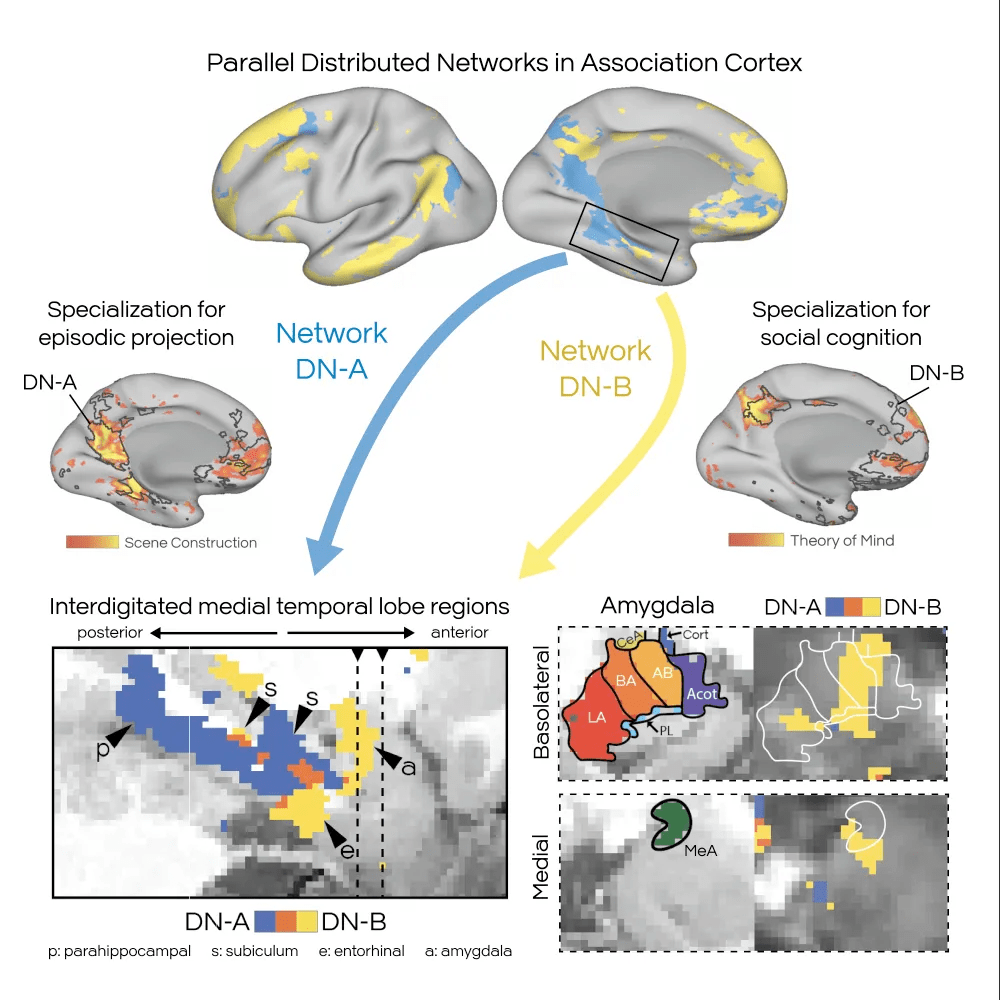
I have also been studying connections between the amygdala and insula and connections between the amygdala and other non-social networks.
Publications
2025
Kwon, Y., Salvo, J.J., Anderson, N., Edmonds, D., Holubecki, A., Lakshman, M., Yoo, K., Yeo, T., Kay, K., Gratton, C., & Braga, R. (2025). Situating the salience and parietal memory networks in the context of multiple parallel distributed networks using precision functional mapping. Cell Reports,44(1). https://doi.org/10.1016/j.celrep.2024.115207
2024
Edmonds, D., Salvo, J. J., Anderson, N., Lakshman, M., Yang, Q., Kay, K., Zelano, C., & Braga, R. M. (2024). Social cognitive regions of human association cortex are selectively connected to the amygdala. Science Advances, 10(47), 23752548. https://doi.org/10.1126/sciadv.adp0453
Howard, J. D., Edmonds, D., Schoenbaum, G., & Kahnt, T. (2024). Distributed midbrain responses signal the content of positive identity prediction errors. Current Biology, 34(18), 4240-4247.e4. https://doi.org/10.1016/j.cub.2024.07.105
2023
Porter, A., Nielsen, A., Dorn, M., Dworetsky, A., Edmonds, D., & Gratton, C. (2023). Masked features of task states found individual brain networks. Cerebral Cortex, 33(6), 2879–2900. https://doi.org/10.1093/cercor/bhac247
2021
Waller, R., Corbett, N., Raine, A., Wagner, N. J., Broussard, A., Edmonds, D., Reardon, S., Jones, C., Itkin-Ofer, M., Schell, T., & Neumann, C. S. (2021). Reduced sensitivity to affiliation and psychopathic traits. Personality Disorders: Theory Research, and Treatment, 12(5), 437–447. https://doi.org/10.1037/per0000423
 Donnisa Edmonds